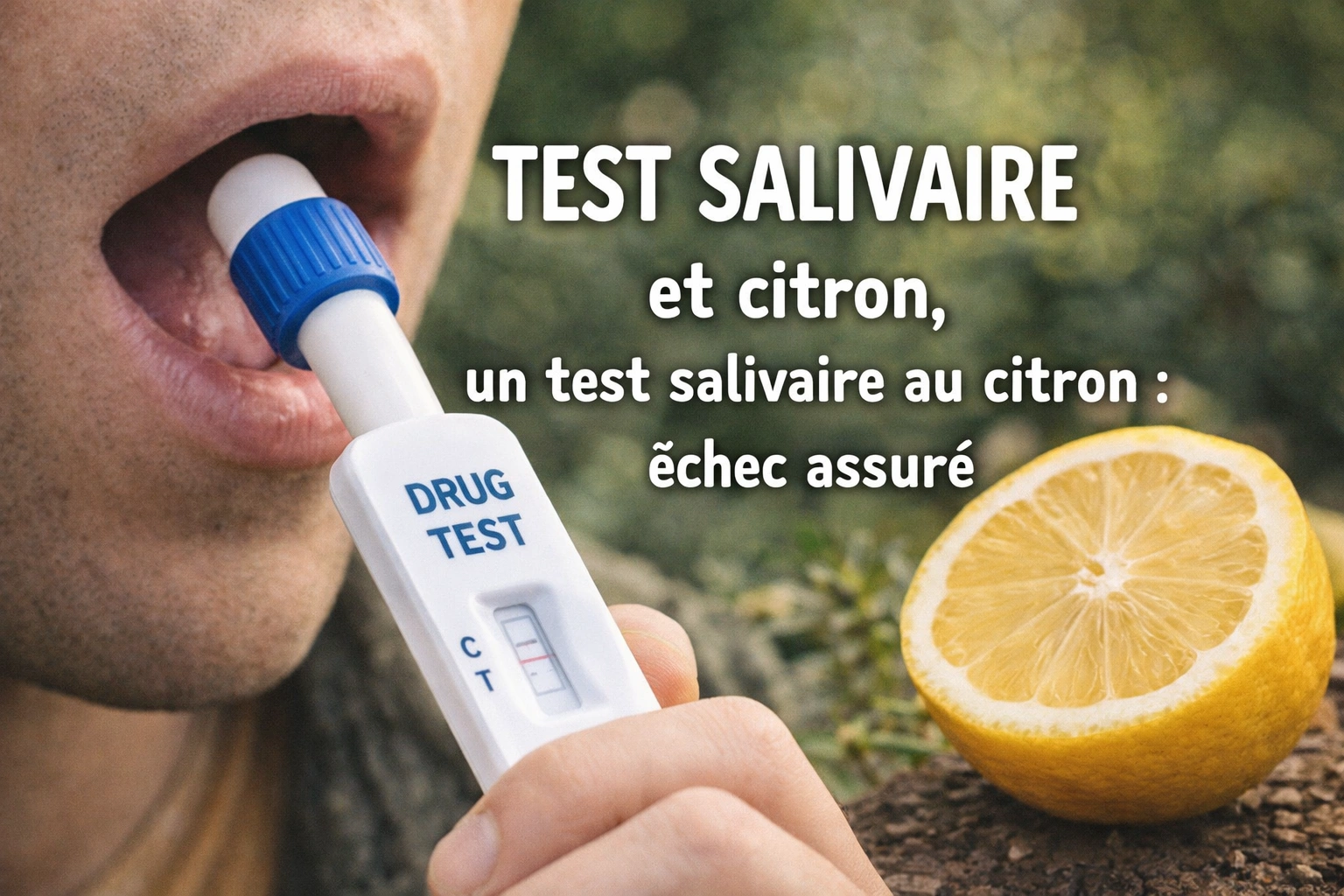
No: there is no reliable way to beat a saliva drug test. Lemon juice, vinegar, mouthwash, chewing gum, hydrogen peroxide or an ‘anti-THC’ spray bought online: none of them removes the THC that coats the inside of your mouth, and none of them fools the laboratory analysis that follows a positive roadside screen, whether that is a second saliva sample (France, Spain) or a blood test (Germany, the Netherlands, Ireland, the UK). The only thing that really matters is the time since you last consumed, and the only answer that holds up is not to get behind the wheel after smoking.
‘How do you beat a saliva drug test?’ is still one of the most searched questions on the subject, in every language, and the answers floating around mix everything up: forum legends, sales pitches for sprays and half-truths about science. We went through each ‘trick’ one by one, with what toxicology studies actually say and, above all, what the procedure looks like across Europe, because it never stops at the swab on the roadside.
Another point many people miss: trying to cheat often costs more than the test itself. In most European countries, refusing the test is an offence in its own right: in France it carries the same penalties as a positive result, up to three years in prison and a €9,000 fine, and in Spain it can be prosecuted as a crime. And a clear swab does not make you untouchable: in several countries, officers can act on clear signs that you are unfit to drive.
The key points in 30 seconds
• No trick works: lemon, mouthwash and sprays sold online do not remove the THC bound to the lining of your mouth.
• A positive screen leads to a sample analysed in a laboratory: saliva or blood depending on the country. Some countries sanction any trace of THC, others set a very low blood limit.
• Refusing is an offence almost everywhere, often punished as harshly as a positive result.
• After a single joint, THC can stay detectable in saliva for more than a day at laboratory thresholds: the only solution is not to drive.
 Best-sellerSmall Bud AK-47from 0.90 €/gVoir
How does a saliva drug test work at the roadside in Europe?
There is no single European drug-driving law: each country sets its own rules. But the logic is the same almost everywhere. Police can screen drivers at the roadside, in some countries, such as France and Spain, without any particular reason during routine checks, in others, such as Great Britain, only on suspicion, after a traffic offence or after an accident. In practice, the smell of cannabis in the car or a remark about your eyes is often enough to start the procedure.
The procedure has several stages:
- The roadside screen: a saliva kit rubbed on your tongue or the inside of your cheek, giving a result in a few minutes. It only decides what happens next. Some forces also assess your behaviour and coordination.
- The confirmation: if the screen is positive, a sample is taken for a laboratory. In France and Spain it is usually a second saliva sample taken on the spot; in Germany, the Netherlands, Switzerland, Ireland and the United Kingdom it is a blood sample taken by a doctor or at a police station.
- The counter-analysis: most countries let you challenge the result. In France you can ask for a blood sample to be kept and analysed by another laboratory; in Spain you can ask for a blood contrast test; in Great Britain you can ask for part of your blood sample.
- The licence: in several countries it can be taken away before any trial. In France, for example, it can be retained on the spot for up to 120 hours while waiting for the results, then suspended by the prefect.
Here is what changes from one country to the next. The figures below are the main rules for an adult driver on a first offence; repeat offences, accidents or mixing with alcohol are punished more heavily.
| Country | Evidence | THC rule for drivers | Main penalty (first offence) |
|---|---|---|---|
| France | Saliva analysed in a lab (blood on request) | No tolerated level: any THC detected | Up to 3 years in prison, €9,000 fine, 6 points |
| Spain | Second saliva sample in a lab (blood contrast possible) | Zero tolerance: presence is enough | €1,000 fine, 6 points; a crime if your driving is impaired |
| Germany | Blood test | 3.5 ng/ml in blood serum; total ban for under-21s and probationary drivers | €500, 1-month ban, 2 points |
| Netherlands | Blood test | 3 µg per litre of blood | Criminal offence: fine and licence consequences |
| Italy | Lab analysis of saliva or blood | Driving after taking drugs is an offence when it endangers road safety (Constitutional Court, January 2026) | Fine, licence suspension, compulsory medical check |
| Switzerland | Blood test | 1.5 µg per litre of blood | Criminal offence, licence withdrawal |
| Ireland | Blood test | 1 ng/ml of blood | Fine up to €5,000, minimum 1-year ban |
| Great Britain | Blood test | 2 µg per litre of blood | Up to 6 months in prison, unlimited fine, minimum 1-year ban |
Remember this above all: what proves the offence is the laboratory analysis, not the strip. And a limit is not a tolerance: the blood limits above were set very low, to rule out accidental exposure, not to allow ‘a little’ cannabis before driving. In France, the lab detection threshold is 1 nanogram of THC per millilitre of saliva, a tiny amount, and there is no ‘authorised level’ at all. Rules are changing fast, so check before you travel: the EU’s Your Europe road rules pages list each country, and the British government has its own drug driving page.
Finally, the test does not look for ‘cannabis’ in general: it targets THC, the psychoactive molecule of the plant. That is what would have to disappear, and that is precisely what no trick can achieve.
Why THC does not leave your saliva in five minutes
When you smoke or vape, THC does not just pass into your blood: it directly coats the lining of your mouth. A 2017 American study by the team of toxicologist Marilyn Huestis (Swortwood et al., Drug Testing and Analysis) found that THC concentrations in saliva peak during or just after consumption, precisely because of this contamination of the oral mucosa. Your mouth becomes a reservoir, and the saliva it constantly produces keeps picking THC up.
For how long? A key study on the subject (Anizan et al., Analytical and Bioanalytical Chemistry, 2013) followed volunteers after a single joint containing 6.8% THC:
- every saliva sample was positive for THC up to 13.5 hours after smoking, in occasional and regular users alike;
- at a threshold of 1 ng/ml, the one used for confirmation in France, THC remained detectable for a median of 27 hours in occasional users and more than 30 hours in regular users (30 hours being the end of the follow-up);
- in heavy users, other work by the same team (Newmeyer et al., 2014) shows positive results for even longer than in occasional users.
Roadside devices use their own cut-offs, which vary from one model to another, so these figures are not a countdown. They do show one thing clearly: everything that acts ‘on the surface’, such as rinsing, chewing, acidifying or diluting, does not touch that reservoir. That is the underlying reason why all the tricks below fail. And the confirmation sample goes to a laboratory far more sensitive than any roadside kit.
The 7 tricks to beat a saliva drug test, put to the test
1. Lemon (and vinegar)
What you read: sucking a lemon or rinsing with vinegar would ‘neutralise’ THC by changing the pH of your saliva.
What we know: no scientific publication describes THC being destroyed by lemon juice or household vinegar. Acidity has one well-known effect: it makes you salivate, and that fresh saliva comes from the same THC-coated mouth. Repeated acid also attacks tooth enamel. And a driver who turns up at a police check with a lemon in hand or vinegar breath draws attention more than anything else. Verdict: myth.
2. Mouthwash, brushing your teeth and chewing gum
What you read: cleaning your mouth thoroughly, with a shop-bought mouthwash or a homemade ‘anti-THC’ recipe, would wipe out the THC.
What we know: a study published in Forensic Science International (Wong et al., 2005) looked at two products sold specifically to beat saliva tests. Conclusion: they do not destroy drug molecules or change the pH of saliva; they simply rinse the mouth, no more and no less than an ordinary mouthwash. Nothing shows that rinsing clears THC from the mucosa: saliva is renewed and keeps collecting it. As for chewing gum or mints, they hide the smell, not the molecule. We look at homemade recipes in more detail in our article DIY anti-THC spray: does it work? Verdict: myth.
3. Drinking litres of water
What you read: drinking huge amounts would ‘dilute’ THC below the detection threshold.
What we know: the idea comes from urine tests, where laboratories spot dilution anyway. Saliva is not urine: the water you drink does not wash the lining of your mouth and changes nothing about the THC stored there, let alone in your blood. Drinking extreme amounts of water in a short time can even be dangerous. Verdict: myth.
4. Hydrogen peroxide
What you read: rinsing your mouth with hydrogen peroxide would ‘oxidise’ the THC.
What we know: this is the riskiest of all. Hydrogen peroxide is an antiseptic for the skin, not something to hold in your mouth or swallow: it irritates mucous membranes and swallowing it can cause injury. No data show that it makes a driver who has consumed test negative, and the laboratory analysis is still to come. Verdict: dangerous myth, never try it.
5. Olive oil, milk and fatty meals
What you read: since THC loves fat, a spoonful of oil or a glass of milk would ‘capture’ the THC in your mouth.
What we know: THC is indeed a lipophilic molecule, stored in the body’s fat. But that is exactly what explains why it lingers in regular users, not a way to remove it from saliva. No study shows that fatty food lowers THC in saliva enough to turn a test negative. Verdict: myth.
6. ‘Anti-THC’ sprays and products sold online
What you read: a spray or rinse costing a few euros would ‘neutralise THC in minutes’.
What we know: these products are marketing, not toxicology. The 2005 study mentioned above showed that their only mechanism is rinsing, with no chemical action on drugs. To our knowledge, no independent study shows that they make a driver who has consumed test negative, let alone get past a laboratory analysis. Verdict: a sales pitch, not a solution.
7. ‘Detox’ drinks, herbal teas, exercise and saunas
What you read: a detox, a workout or a sauna the night before would ‘clean out’ your system.
What we know: these methods target the whole body, not the mouth, and none has been shown to speed up the elimination of recent THC from saliva. Sweating comes up often, but sweating has never emptied the lining of a mouth. Verdict: no effect on a saliva test.
Summary table
| Trick | What people claim | What science shows | Extra risk |
|---|---|---|---|
| Lemon, vinegar | Acidity neutralises THC | No destruction of THC, makes you salivate | Tooth enamel, suspicion at the check |
| Mouthwash, brushing, chewing gum | A clean mouth wipes out THC | Simple rinse, THC stays in the mucosa | No gain, behaviour noticed |
| Drinking lots of water | Dilution brings you under the limit | No effect on saliva or blood | Dangerous in very large amounts |
| Hydrogen peroxide | It oxidises THC | No evidence it works | Irritation, injury if swallowed |
| Oil, milk, fatty meals | Fat captures THC | No proven effect on saliva | No gain |
| ‘Anti-THC’ sprays | Negative in minutes | Rinsing, no chemical action | Money wasted, false confidence |
| Detox, exercise, sauna | Clean out your system | Nothing on recent THC in saliva | False confidence |
| Waiting and not driving | Too simple to be true | The only method that works | None |
Les best-sellers de la boutique
Cheating or refusing: what the law says across Europe
Many drivers imagine that a ‘failed’ or refused test will get them off the hook. It is the other way round: almost every European country has an offence for refusal, and it is often punished as heavily as a positive result.
| Country | What refusing can cost |
|---|---|
| France | An offence in itself (article L235-3 of the Highway Code): up to 3 years in prison, a €9,000 fine and 6 points, exactly like a positive result |
| Spain | Can be prosecuted as a crime (article 383 of the Criminal Code): prison and a driving ban of up to 4 years |
| Germany | The roadside screen is voluntary, but police can then order a blood test |
| Netherlands | Refusing the saliva test is an offence (fine); a blood test can be ordered and you must cooperate |
| Ireland | Refusing a test or a specimen is an offence in itself |
| Great Britain | Roadside test: fine up to £1,000 and 4 points. Evidential sample at the station: up to 6 months in prison, an unlimited fine and a ban of at least a year |
Three points are worth stressing:
- Refusing protects you from nothing. Wherever you are, refusal is either punished as a crime, treated like a positive result, or simply replaced by a blood test the police can order.
- A clear swab is not a free pass. Since August 2026, France can prosecute a driver who has manifestly used drugs, based on what officers observe, without waiting for a positive analysis. Great Britain has long had an offence of driving while unfit through drugs, and in Spain impaired driving is a crime.
- A conviction follows you. Insurance premiums can rise sharply, a criminal record can complicate travel to some countries, and a ban in one EU country can have consequences for your licence elsewhere.
In the event of an accident causing injury or death, the stakes change completely. France created the offence of ‘homicide routier’ (road homicide) in July 2025, with drug use as an aggravating factor, and in Great Britain causing death by careless driving under the influence of drugs can carry a life sentence. At that point, we are no longer talking about a lost licence but about lives damaged, your own included.
The only real answer: let time pass and do not drive
Many people search for ‘how to get THC out of your saliva naturally’. The honest answer fits in one sentence: only time clears THC from your saliva and your blood, and nothing has been shown to shorten that delay.
That delay depends on several factors:
- how often you consume: regular use clearly lengthens the detection window;
- the amount and the THC content of what you consumed;
- how you consume it: smoking or vaping deposits THC straight into the mouth, whether it is a joint or a herb vaporiser;
- the test threshold: at 1 ng/ml, THC can remain detectable in saliva more than a day after a single joint.
In practice, if you have consumed: leave the car. Public transport, a taxi, a sober friend who drives, or a night where you are: every one of these options costs less than a suspended licence. The same applies on the way back from a trip, for example after a weekend in the Netherlands (see our article on bringing cannabis back from Amsterdam). Beyond the police check, THC affects alertness and reaction times, which is the very reason for these laws. A negative home test bought online is no green light either: its sensitivity is not that of a laboratory analysis.
What about CBD: can it trigger the test?
CBD flowers and resins are legal in France and in many EU countries under 0.3 % THC, but rules differ, so check the law in your country. The United Kingdom, for example, treats smokable CBD flowers as controlled cannabis. Whatever the country, the roadside test looks for THC, not CBD.
But CBD is not a trick either. A legal flower contains traces of THC, and heavy use can leave enough in your saliva to exceed a laboratory threshold. In France, the Cour de cassation ruled in June 2023 that the offence is made out as soon as the analysis finds THC, even if the driver says they only used CBD. Products bought from unreliable sources can also contain more THC than their label suggests.
The answer is not to give up CBD: it is to know what you use and when. At Jungle Kush, our organic CBD flowers and CBD hash come with documented levels, and our French organic CBD range is grown in France, organic, under 0.3 % THC, from lab-tested batches and shipped across Europe. If THC is a real concern for you, Panakeia 0% THC is an organic flower sold without THC. Either way, the rule of caution is the same: no driving straight afterwards.

FR Organic Pack
Flowers and hash 100 % grown in France, under 0.3 % THC, lab-tested batches: legal in France, for the evenings when you are not driving.
Not sure where to start? The classic White Widow CBG, grown organically in France, and the soft, fragrant Lebanese hash are two good places to start, along with the THC-free Panakeia below. If you are curious about what research actually says about CBD, read our page on the benefits of CBD and what the science really says. And if you are planning a trip to the Netherlands, see our articles on cannabis oil in Amsterdam and on buying Dutch cannabis online.
Panakeia 0% THC - Organic THC-free CBD flower
An organic CBD flower sold without THC, for people who want the plant without the molecule roadside tests look for. Shipped across Europe.
What about at work?
Part of the searches on saliva tests concern the workplace. Rules depend on the country, but the broad principles are similar across Europe: an employer cannot test just anyone. Testing must be justified by the job and proportionate, set out in advance in the company rules, the contract or the staff handbook, and in practice it is reserved for safety-critical roles (driving, machinery, dangerous goods, rail and so on). In some countries, such as the United Kingdom, it generally also requires the employee’s consent.
Refusing a test provided for in your workplace rules, a positive result or an attempt to tamper with a sample can lead to disciplinary action, up to dismissal in the most serious cases. Here again, cheating exposes you more than the test itself.
Frequently asked questions
Can lemon make a saliva drug test negative?
No. No study shows that lemon’s acidity destroys THC; it mostly makes you salivate. And a positive screen is followed by a laboratory analysis anyway, of saliva or blood depending on the country.
Does mouthwash help you beat a saliva drug test?
No. The ‘anti-THC’ products that have been studied simply rinse the mouth, with no chemical action on THC, which stays bound to the lining of the mouth.
Does hydrogen peroxide affect a saliva drug test?
No, and it is dangerous: hydrogen peroxide irritates mucous membranes and must never be swallowed. No data show that it makes a test negative.
How long after a joint will a saliva test be positive?
At least several hours, and often more than a day at laboratory thresholds, longer for regular users. No delay is guaranteed, and in countries with zero tolerance or a very low blood limit, the safest choice is not to drive.
Can you refuse a roadside drug test in Europe?
In most countries, refusing is an offence. In France it carries the same penalties as a positive result (up to 3 years in prison and a €9,000 fine), in Spain it can be prosecuted as a crime, and in Great Britain refusing the evidential sample brings a ban of at least a year. In Germany and the Netherlands, police can order a blood test instead.
The last word
Tips to beat a saliva drug test have been doing the rounds for years because they are reassuring, not because they work. Faced with a procedure that always ends in a laboratory, and laws that punish refusal and impairment as well as THC itself, there is only one reliable strategy, whichever country you drive in: do not drive after using cannabis.
This article is for information only and is not legal or medical advice. Information checked in November 2026 for France, Spain, Germany, the Netherlands, Italy, Switzerland, Ireland and Great Britain; laws change, so check the rules of the country you drive in.
Nos meilleures ventesView all
Organic small budsAK-47from 0.90 €/gVoir HashOgivefrom 6.56 €/gVoir
 Strong CBDMike Tysonfrom 4.34 €/gVoir
 Small budsSmall Buds OG Purple Kushfrom 1.50 €/gVoir
 Strong CBDAnimal Tsunamifrom 5.60 €/gVoir
 HashSub Zerofrom 4.00 €/gVoir
 Small budsSmall Bud Bubble Gumfrom 0.90 €/gVoir
 HashGold Gaz Marocainfrom 4.68 €/gVoir